

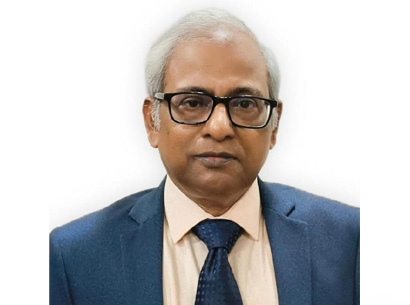
Dr. Pulak Munshi

Dean Infrastructure & Planning

Dean Infrastructure & Planning

The office of the Dean Infrastructure and Planning (DoIP) is responsible for the implementation of future Vision of the Institute related to the Infrastructure Augmentation for upgradation and upliftment of the Main Campus and other off-campuses.

PORTFOLIO of Dean Infrastructure & Planning:

  • Planning & Designing for all future Expansion related to Infrastructure Augmentation of the University
  • Construction & Planning
  • Environment & Green Campus measures
  • Renovation & Remodeling of Campus Housing
  • Renovation and Remodeling of all Campus Facilities and Amenities
  • Utility Services
  • Building and Works Committee
  • Coordination with all Extension Centers related to Construction & Renovation
  • Coordination with Local/Central Government on regulatory issues
  • Digital Infrastructure

The Dean, Infrastructure & Planning (Dean IP) has full responsibility of creation of new Infrastructure, and maintenance of existing civil infrastructure in the BIT Mesra campus. The civil infrastructure includes all buildings in the academic area, residential hostels for students, staff accommodation of various types, buildings for general facilities and amenities, roads, gardens, playgrounds, along with related utilities such as water supply, electricity supply for the whole campus.

The Dean IP is also expected to be responsible to all estate related matters that may come up time to time related to space allocation for different academic, administrative and other functional spaces, recreation areas within the campus.

Specifically the following key units of the Institute will be accountable to Dean of Infrastructure & Planning :

  1. DESIGN DEVELOPMENT CELL : For all Architectural, Structural, Interior, Services Design
  2. ENVIRONMENT & GREEN CAMPUS APPROACH: for achieving a systematic growth of overall infrastructure with minimal disturbance to the environment and preserving the flora and fauna of the campus.
  3. CENTRAL MAINTENANCE CELL: For civil maintenance, water supply & sanitation, electrical services etc.


Dr. Pulak Munshi
Professor of Practice,

DEAN, Infrastructure & Planning
Birla Institute of Technology

Mesra, RANCHI, Jharkhand
Tel : +91-651 2275872

Email : doip@bitmesra.ac.in

RACHEL HPC FACILITY Resource Usage Policy

Policy Overview

Date: 11 March 2026

The Rachel High Performance Computing (HPC) Facility provides shared computational infrastructure to support the research, teaching, and scholarly activities of the institution. To ensure equitable access and the efficient utilization of these resources, all registered users are required to read, understand, and comply with the provisions set out in this Policy. These guidelines are effective immediately upon account activation and apply to all submitted workloads, stored data, and system interactions.

ParameterLimit / Requirement
Maximum Job Runtime120 hours (5 consecutive days)
Per-User Storage Quota150 GB (unauthorised use prohibited)
Job MonitoringUser's ongoing responsibility
Storage MaintenancePeriodic review & cleanup required
Non-Compliance ActionJob termination / access suspension

Job Runtime Limit

No user shall be permitted to execute any computational job on the Rachel HPC cluster for a continuous period exceeding total 120 hours (CPU-5 consecutive days or GPU-3 consecutive days). Jobs that approach or exceed this threshold will be subject to administrative intervention, including automatic or manual termination, to preserve system availability for all users.

Users requiring extended runtime beyond the standard limit must submit a written request to the System Administrator prior to job submission, providing scientific justification and an estimated resource budget.

Storage Utilization Limit

Individual users shall not utilize more than total 150 GB (for CPU nCPU-12 Core & for GPU nGPU-6 Core) of storage on the Rachel HPC system without prior written authorization from the System Administration team. This quota encompasses all personal directories, project workspace, and temporary scratch areas associated with the user account.

The following storage hygiene practices are mandatory:

  • Removal of completed job output files that are no longer required for active analysis.
  • Deletion of temporary, intermediate, and scratch files upon job completion.
  • Regular archival of results to institutional long-term storage systems.
  • Prompt response to storage-usage alerts issued by System Administration.

Fair Resource Usage

All users are expected to exercise good judgement in their use of Rachel HPC resources. Users shall not monopolies CPUs, memory, network bandwidth, or storage in a manner that disrupts or prevents other researchers, faculty members, or students from accessing the facility.

Submitting large numbers of simultaneous jobs that saturate the scheduler queue without scientific necessity, or deliberately circumventing resource allocation controls, constitutes a violation of this Policy.

Job Monitoring Responsibility

Users bear full responsibility for monitoring all jobs they submit to the Rachel HPC scheduler. This responsibility includes:

  • Regularly checking job status, output logs, and resource-consumption metrics.
  • Promptly terminating any job found to be stalled, malfunctioning, or producing incorrect results.
  • Ensuring that submitted jobs do not run beyond their stated resource requirements.

Users who are unable to actively monitor a job due to absence or other commitments should make arrangements for a designated colleague to assume monitoring responsibility, or should limit job scope accordingly.

Storage Maintenance

Users shall periodically review their allocated storage space and proactively remove unnecessary files, redundant datasets, temporary data, and intermediate outputs. Maintaining adequate free capacity on the Rachel HPC storage systems is a shared responsibility that directly impacts the productivity of all users.

System Administration may issue storage-usage warnings when a user's allocation approaches the permitted quota. Users are expected to respond to such warnings within five (5) working days by reducing their storage footprint to within the authorized limit.

Policy Compliance

All users of the Rachel HPC facility are required to comply with the provisions of this Policy as a condition of continued access. Compliance is the personal responsibility of every account holder.

âš   Non-Compliance & Administrative Authority Failure to comply with any provision of this Policy may result in the immediate termination of running jobs, restriction of computational resource allocations, or temporary suspension of access privileges to the Rachel HPC facility. The System Administrator reserves the right to terminate any user process deemed to be making undue or excessive use of system resources, without prior notice, in order to maintain overall system stability and equitable access for all users.


Signature of HOD (CSE)